Better Product Decisions Start With Better Evidence
Most product failures aren't caused by poor execution—they're caused by assumptions that were never tested. Assumption Artifacts helps product teams identify their highest-risk assumptions, gather evidence from real human behavior, and make decisions with greater confidence.
Just Published! Deep dive into the research behind Assumption Artifacts - Beyond the Double Diamond: Teaching Risk-Based Decision Making through the Uncertainty Model and Assumption Artifacts.
Contact Raelin Musuraca, raelin@cmu.edu, to book a guest lecture at your organization.
Most product teams follow the right process and still build the wrong thing. The problem is rarely execution—it is untested assumptions.
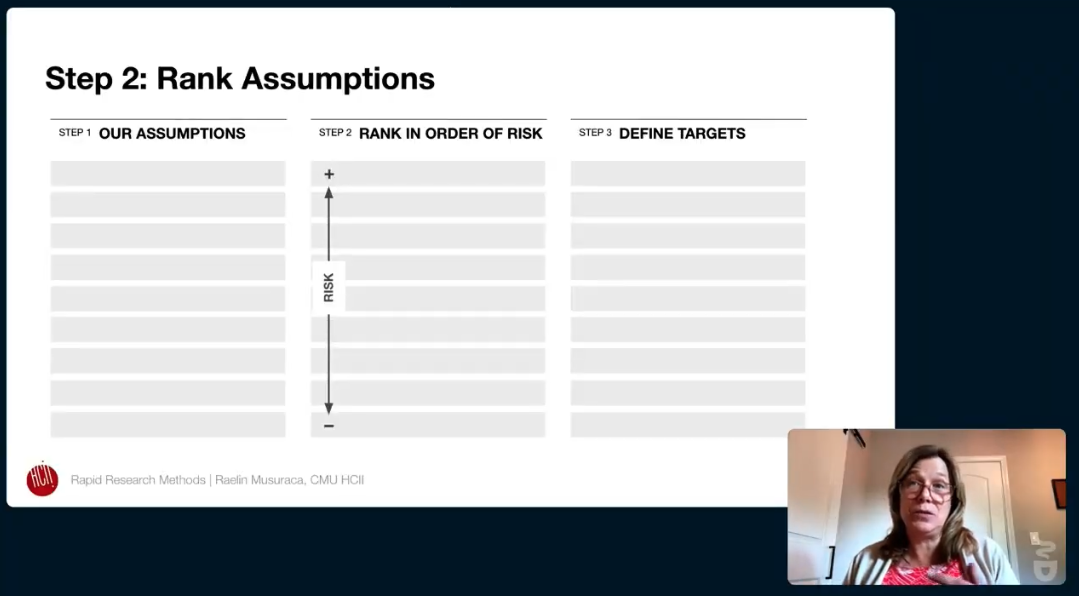
Assumption Artifacts is a risk-based, human-centered research method that helps product managers identify the beliefs driving their decisions and test them before committing significant resources. Rather than starting with features or solutions, teams begin by identifying the assumptions that carry the greatest risk to a product’s success, then design lightweight experiments to gather evidence about the human behaviors those assumptions depend on.
At its core, the method is built on a simple idea: product decisions improve when uncertainty is reduced before investments are made. Teams define the specific behavior they need to observe, then create the smallest possible artifact capable of eliciting that behavior. The goal is not to collect opinions about a concept, but to generate evidence that can validate or invalidate a critical assumption.
Drawing on Lean Startup principles, human-centered design, and research on behavioral signals, Assumption Artifacts helps teams move beyond what users say to evidence grounded in observable actions. By focusing on behavior rather than preference, teams can uncover hidden risks, prioritize learning, and make product decisions with greater confidence while keeping research fast, practical, and rigorous.
The result is a framework for reducing uncertainty, validating assumptions, and building products based on evidence rather than intuition alone.